



Quick verdict: SDC is a real, long-running swinger community with genuine members and genuine events — but it looks and behaves like software from another decade, and almost nothing useful works without paying. This SDC review is aimed at couples and open-minded singles in the USA who already know what lifestyle dating means and want parties, travel meetups and club connections. If you're hoping for a slick app that hands you matches, or you're just curious about casual dating in general, skip it and look at the comparison table above instead.
What SDC Is and Who It Was Built For
Swingers Date Club launched back in 1999 and claims more than three million members worldwide, with a large chunk in the USA plus strong numbers in Europe and Latin America. It's not a general dating site. It's a lifestyle platform: couples looking for other couples, single women and men joining play events, plus corners for bisexual, voyeur and BDSM interests. Alongside profiles you get party listings, club directories, lifestyle travel and cruise bookings, chat rooms with webcams, and a blog and shop area. It's fully available in the USA on desktop, and there are iOS and Android apps. Registration is free, and you can see enough on a free look to judge whether the vibe fits you.
Worth creating a free account first — you'll know within twenty minutes whether the community feels active near you.
The Sales Pitch Versus Our First Impressions of SDC
The pitch is bold: the world's biggest swinger community, endless verified couples, parties every weekend, a "success rate" that supposedly beats everything else. Lovezoid's review team spent several weeks inside SDC testing those claims from a US-based profile, and the first impression was a mix of impressed and irritated.
Impressed, because the site does not feel fake. Real event listings with real club names, dates and dress codes. Profiles with long, specific write-ups instead of one-line bios. Couples who list which state they're in, which clubs they attend and what they're comfortable with. That's rare and it matters — in the lifestyle space, plenty of platforms are full of single men pretending to be couples.
Irritated, because the interface is genuinely dated. The layout is dense, with small text, stacked menus and buttons in odd places. Some pages still open in new windows. On desktop I counted three different places to look at messages before I understood which one was the actual inbox. The design has been patched over the years rather than rebuilt, and it shows. If you expect a clean card-swipe experience, the first ten minutes will feel like homework.
The second thing that hit me: the paywall arrives early and often. On a free account I could read chat rooms but not talk in them. I could see the first photo on a profile but not the rest. I could receive an instant message and see that someone had written to me — but not reply. That's a deliberate design choice, and it's the single biggest thing to know before signing up.
Testing Activity Levels, Search Tools and Message Quality
Here's where a review earns its keep. Claims are cheap; logged-in behavior isn't.
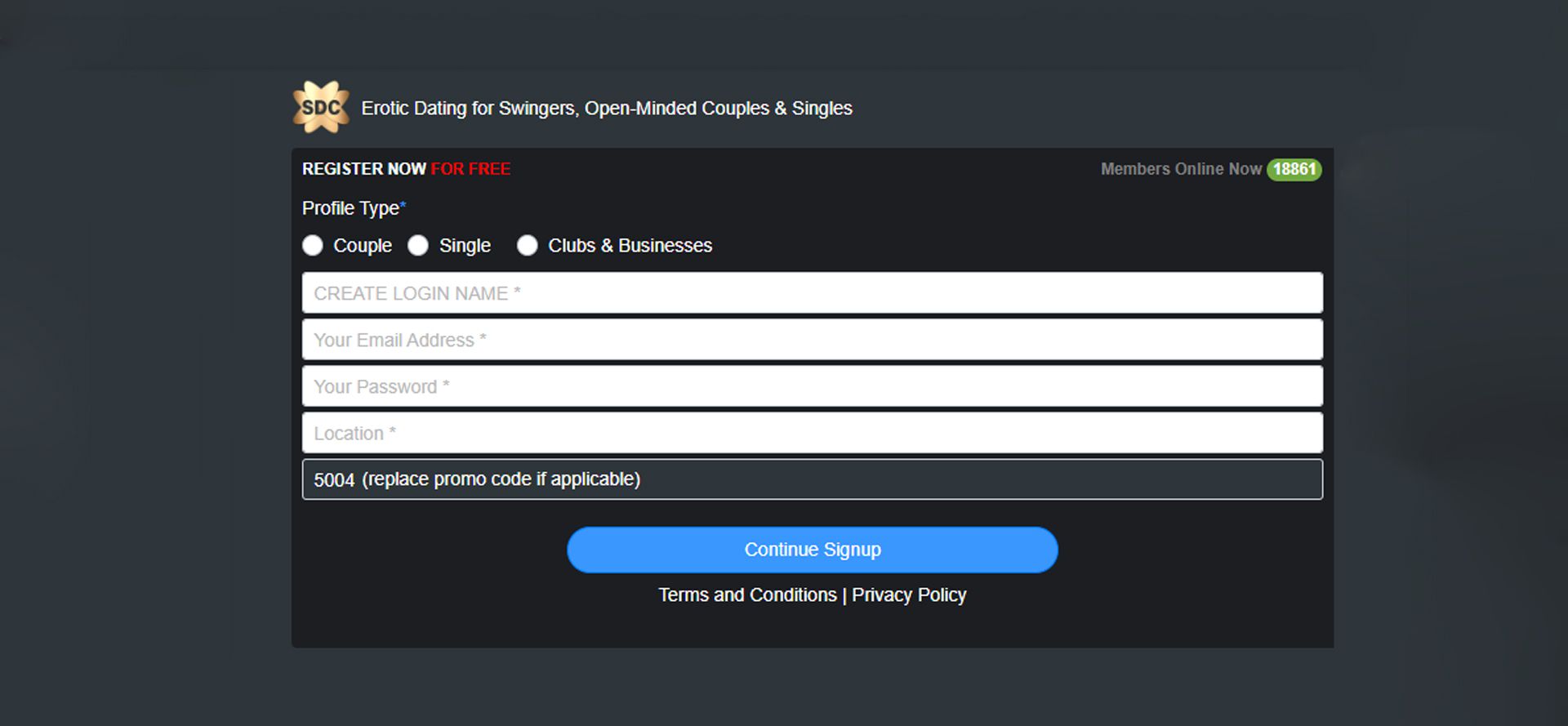
Sign-up. Registration is quick and asks more sexual detail than most people expect. You declare whether you're a single man, single woman or couple, your orientation, who you're looking for, then work through checklists of what you're into and what's off the table. The steps look like this:
- Open the SDC site or install the app, then choose sign up instead of login.
- Set your status (single or couple) and orientation, plus who you want to meet.
- Write a headline and description — vague ones get ignored fast here.
- Upload a clear photo; profiles without one get very little attention.
- Pick the traits and appearance options that describe you.
- Work through the sexual interests checklist — yes, no, maybe.
- Confirm your email address to activate the profile.
The whole thing took me about eight minutes. Email verification is mandatory, which cuts down the drive-by junk accounts.
Matching. There isn't one. SDC does not use an algorithm, compatibility scoring or daily suggestions. You search and you browse, full stop. For some people that's a plus — you're not being fed whatever the system wants to show you. For others it's a real limitation, because you have to put in the work every session. If you like being handed matches, one of the question-based matching platforms will feel much more comfortable than this.
Search. The search tab is actually the strongest part of the site. You can filter by location and distance, status (couple, single female, single male), age range, orientation, body type, interests and whether the profile has photos or is currently online. That's far deeper than the three or four filters most apps allow. The presentation is clunky — results load in a plain grid with tiny thumbnails — but the filtering itself does the job. Searching a 50-mile radius around a major US metro gave me hundreds of profiles with logins inside the past month.
Activity levels. This is location-dependent in a big way. In and around large cities — Los Angeles, Las Vegas, Houston, Miami, Chicago, Atlanta, the New York/New Jersey area — the site is clearly alive: recent logins, upcoming parties, active chat rooms in the evenings. In smaller markets and rural states, I found profiles whose last login was two or three years ago still sitting in results. There's no strong system pushing dormant accounts out of view, so you have to check dates yourself. That's an annoyance you'll get used to.
Communication. Private messages, chat rooms with webcam support, profile likes, event and party invitations, plus a member "validation" system where users vouch for people they've actually met. That validation feature surprised me — it's the most useful thing on the whole platform. A profile with several validations from other established members is about as close to proof of a real person as online dating gets. Members can also toggle messages on or off, shown by a green marker on the profile, so you're not wasting time writing to someone who has closed their inbox.
Reply rates. As a single male tester, replies were slow and rare, which is normal in the lifestyle. As a couple profile, response rates were far better — several genuine conversations within the first week, mostly about local clubs and upcoming events rather than instant hookups. And that's the honest reality of SDC: it's a community that arranges real-world meetups, not a place where a message turns into a same-night date.
The app. Functional, not polished. It handles messaging, event listings, party reservations, speed dating and travel bookings, and it mirrors the mobile web layout closely. Photo loading is slow on cellular, notifications were inconsistent during our 2026 testing (I twice found messages in the app that never triggered an alert), and several features are locked behind a paid plan. It's a companion to the website rather than a replacement.
If the profiles in your area look active, a free account is enough to check that before you spend anything.
The Real Cost of an SDC Membership, Fully Explained
SDC calls itself free, and technically there's a free tier plus a seven-day trial window. What that actually gets you is limited:
- Read chat rooms, but not post in them
- See only the first photo on each profile
- Receive instant messages without being able to reply
- Receive validations from other members
- Read the community blogs
Notice what's missing: sending messages, seeing full photo galleries, using webcams, and — this one genuinely annoyed me — editing your own profile after setup. Locking profile edits behind a subscription feels like a squeeze rather than a feature.
Paid plans, in US dollars, run roughly like this. Starter is about $29.95 for one month. Classic is around $54.94 for three months, which works out near $19.98 a month. Premium is about $99.96 for six months, roughly $16.66 monthly. Comfort is about $150 for twelve months, roughly $12.50 a month. Prices shift with promotions and currency, so check the checkout page before you commit.
Upgrading unlocks the whole platform: sending and reading chat, webcam use in chat rooms, contacting members, seeing all photos, giving and receiving validations, editing your profile, and posting blogs. It's a clean split — free is a display window, paid is the actual product.
Now the honest math. Paying $29.95 for a single month is poor value, because SDC rewards patience. Conversations here often start weeks before an event you'd attend. One month barely covers the browsing-and-introductions phase. The six or twelve-month plans are where the price starts making sense — under $17 a month for a platform that also gives you event listings and club info is reasonable, if you're actually in the lifestyle and live near an active market.
Two warnings. First, there's no refund policy. None. If you buy twelve months and find your area dead, that's your money gone, which is exactly why you should check local activity on the free tier first. Second, the "promo code" system is not a discount code in the normal sense — it's tied to a physical SDC wristband that gets you perks and reduced entry at partner clubs and events. Useful if you travel to lifestyle events, meaningless if you never leave your city.
The upsell pressure is moderate rather than relentless. You'll hit locked buttons constantly on a free account, but I didn't get bombarded with pop-ups or fake "someone viewed you" bait, which some platforms lean on hard. Small mercy, but I noticed it.
Safety Controls, Privacy Settings and Who Should Actually Join
On safety, SDC is better than average for this niche. Mandatory email verification, member validation from people who have met in person, reporting tools on every profile, and real screening at hosted parties (some organizers verify ID at the door) all raise the floor. Our Lovezoid experts found very few obvious catfish profiles compared with typical hookup platforms — the paywall on messaging removes most of the incentive for scammers, since they can't spam for free.
That said, "few" isn't "none." Watch for the standard warning signs: anyone shifting the conversation to an outside messenger immediately, profiles with a single stolen-looking photo, and above all anybody who raises money, verification fees or gift cards. No legitimate member on SDC needs your financial details, ever. Report and move on.
Privacy controls are decent. You can restrict private photo albums to members you approve, toggle your inbox open or closed, and control who sees certain profile details. What you can't do is hide your profile from search entirely while staying active, and there's no face-blur or photo-verification badge like newer platforms offer. Given how sensitive this content is (a lot of members are in committed relationships and want discretion), I'd like stronger tools here. Use a dedicated email address and avoid identifiable backgrounds in photos.
The most common complaints I found from US users line up with our own testing: dated interface, stale profiles in smaller markets, the no-refund rule, and customer support that answers by email in a day or two rather than instantly. Nothing that suggests a scam — just an older platform running on older habits.
SDC genuinely suits: established couples in the lifestyle, especially in or near big US cities; people who attend clubs, house parties, takeovers or lifestyle cruises; single women, who get plenty of attention; and travelers who want to find events in other cities. It does not suit: single men expecting quick results, total beginners who just want to test the waters cheaply, anyone in a low-population area, or people who need a modern app experience. If you're really after something simpler, a broad social discovery app or a mainstream swipe-based platform will feel far easier. Older singles often do better on sites focused on over-50 dating, and those interested in a very different arrangement sometimes explore mutually beneficial dating setups instead.
Final Verdict on SDC
SDC is legitimate, and after weeks of testing I'd call it the most established lifestyle community operating in the USA. The search filters are deep, the event and club infrastructure is real, the validation system builds actual trust, and the member base in major metros is genuinely active. Those are hard things to fake, and they're the reason the site has survived since 1999.
But it's not a polished product, and it's not cheap for what it looks like. Free accounts can barely function, monthly pricing is steep at nearly $30, there are no refunds, and the matching system simply doesn't exist — you do all the searching yourself. Add the dated interface and the stale profiles outside big cities, and the value depends entirely on who and where you are.
Our rating: about 3.8 out of 5 for couples and single women in active US markets, and closer to 2.5 for single men and anyone outside a metro area. Register free, run a 50-mile search, count how many profiles logged in within the last week, and check whether events are listed near you. If those numbers look healthy, a longer plan at around $12–17 a month is fair value. If they don't, don't spend a cent here — check the comparison table above for platforms that suit you better.
FAQ
Are the couples on swinger and lifestyle sites real, or is it mostly single men pretending to be couples?
Most established lifestyle platforms do have genuine couples, but fake "couple" profiles run by single men are a real and well-known problem. The giveaways are usually no verified photos of both partners, a bio written entirely in "I" instead of "we," and a refusal to do a quick video chat before meeting. Sites that require photo or ID verification and let members leave reviews or vouch for each other cut down on this significantly, so prioritize platforms with those features.
How much does a lifestyle site actually cost once the free trial ends?
Expect roughly $20–$40 per month for a single-month plan, dropping to around $10–$20 per month if you commit to 6 or 12 months. Free accounts on these niche platforms are usually very limited — you can browse and get messages, but you often can't initiate contact or see full photo galleries, which is where most of the value sits. Also check the auto-renewal setting immediately after signing up, since these subscriptions renew by default and refunds are rarely given.
Will people I know in real life be able to find my profile?
There's always some risk, but you can reduce it a lot. Use a nickname instead of your real name, an email address you don't use anywhere else, and photos that have never appeared on your social media (reverse image search is how most people get identified). Good lifestyle platforms let you blur or lock private albums and hide your profile from search entirely until you choose to share access, which is far more privacy control than mainstream apps offer.
How long does it take to actually meet someone from a lifestyle site?
Longer than most newcomers expect — typically several weeks to a couple of months for a first meetup. The lifestyle runs on trust, so experienced members usually want messaging, a video call, and then a low-pressure drink or a club night before anything else happens. Couples get replies faster than single men, who often report weeks of silence and need a verified profile plus a genuinely written bio to get anywhere.
Is a niche lifestyle platform better for me than just using a mainstream app?
If you're specifically looking for open, swinger, or non-monogamous connections, yes — niche platforms are worth it because everyone there already knows the etiquette and you're not explaining yourself or risking a bad reaction. Mainstream apps technically allow couples and open relationships, but the pool is thin, matches often disappear once you explain your situation, and profiles get reported. That said, if you're only curious and not sure what you want yet, start with the free tier of a lifestyle site or an in-person meet-and-greet event before paying for a year.