



Quick verdict: Is EliteSingles worth paying for? For a certain kind of user, yes — if you're a college-educated professional over 30 who wants a serious relationship and you're fine letting an algorithm hand you a small batch of matches each day instead of endless swiping. Skip it if you want casual dating, instant replies, or the ability to message anyone you like without a subscription, because the free version of EliteSingles is close to a demo. Our Lovezoid review team spent several weeks inside the platform in the USA, and this EliteSingles review lays out exactly what we found, including the parts the marketing pages leave out.
Curious enough to look? A free account costs nothing and lets you see the match quality in your own zip code before any money changes hands.
What Is EliteSingles and Who Runs It
EliteSingles launched in the early 2010s and is operated by a large European dating group that runs several relationship-focused brands. It's fully available across the USA, with separate country versions elsewhere, and it markets itself to educated professionals — the site claims roughly 80% of members hold a bachelor's degree or higher, and it reports tens of thousands of new sign-ups each week worldwide. The core age band skews 30 to 55, with a decent number of members in their late 40s and 50s. It is not a swiping app. It's a questionnaire-driven matchmaking service with a website and a companion app for iOS and Android, aimed at people who describe themselves as "done with hookup apps."
Big Promises Measured Against First Impressions
The pitch is easy to summarize: a psychologist-designed personality test, an algorithm built on the five-factor model, a curated group of compatible professionals, and no time-wasters. That's a lot to claim, so it's worth checking each piece.
The sign-up process at least backs up part of the promise. When I registered, the questionnaire ran well past the point where most apps would have let me start browsing. Expect about 20 minutes if you answer honestly, and closer to 30 if you write thoughtful text answers. You're asked how you handle conflict, how tidy you are, how important physical fitness is, how you feel about children, and how you'd describe your ideal Sunday. There's no way to skip it and start looking around — the test gates the whole experience. That filters out anyone who joined out of boredom, which is genuinely a point in EliteSingles' favor.
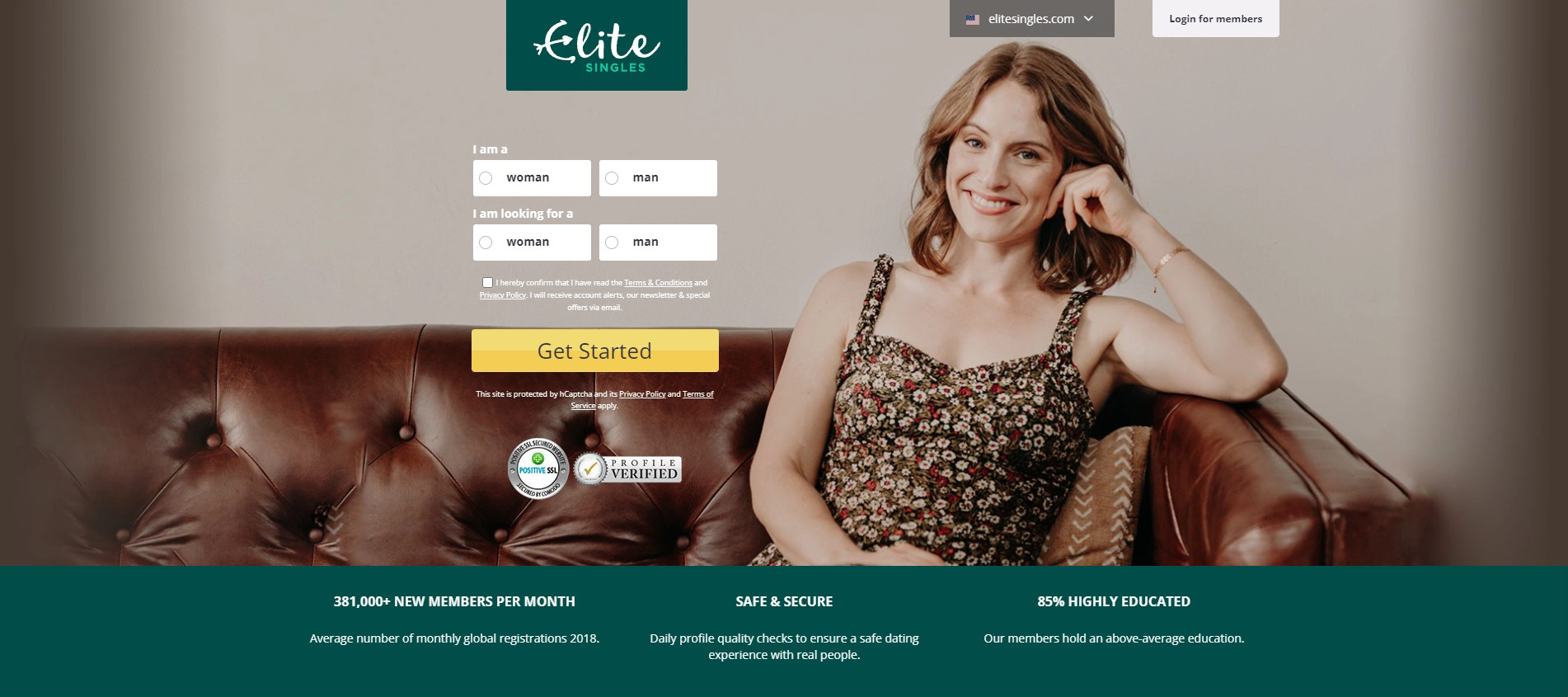
First impressions of the interface were mixed. The desktop site is clean and slow-paced, organized around a daily match feed rather than a search grid. Profiles are text-heavy and actually readable. But the very first thing that happened after I finished the personality test was an upsell screen, and the second thing was a blurred photo grid telling me I couldn't see faces without upgrading. That sets a tone. You spend half an hour on a serious questionnaire, and the reward is a paywall.
The other early surprise was the personality report itself. You get a written breakdown of your traits — openness, conscientiousness, agreeableness and so on — and it's more detailed than the throwaway "personality badges" other platforms hand out. Is it scientifically airtight? I doubt it. Is it interesting enough that I read all of mine? Yes. Whether it produces better matches is the real question, and that took longer to answer.
Testing EliteSingles Claims Over Four Weeks
Here's what our Lovezoid testers tracked: how many daily matches actually arrived, how many were in reasonable driving distance, how many profiles looked genuinely active, and how many messages got replies.
The matching system delivers between three and seven new profiles per day through the main match feed, plus a "Wildcard" section that offers up to 20 extra suggestions with looser criteria. There's also a "Have You Met…" feature that resurfaces profiles you scrolled past. In a large metro area, the daily matches were mostly within 30 miles and mostly age-appropriate. In smaller markets, the algorithm stretched fast — by week two, a tester in a mid-size Midwest city was getting suggestions 90 to 150 miles away. That's the honest limitation of a compatibility-first model: it needs a dense local pool to work, and outside big cities it starts padding the feed.
Profile quality was the strongest part of the test. Because the questionnaire is long, most profiles include real information — job field, education, what they're looking for, and shared traits highlighted at the top so you can see where you overlap. I saw far fewer one-line bios than I expected. People here write in full sentences. That alone makes browsing less exhausting than a swipe feed where quick-swipe apps train people to skip reading anything at all.
Activity levels were fine but not lively. Roughly half the profiles I opened showed recent activity. Reply rates on messages sat somewhere around one in four to one in five — decent for a paid dating site, but you won't get instant conversations. Expect a day or two between replies. This is a platform for people checking in each evening, not people refreshing at a red light.
Communication tools are basic and deliberately limited. You can send likes and "smiles" for free, plus a handful of pre-written icebreaker questions. Real messaging requires premium. As a free member you can technically receive messages from paying members, but you can't reply — which is the single most frustrating thing about the free tier. Nothing stings like seeing an interesting message you're locked out of answering. There are no video calls, no voice notes, no live features. Just profiles, likes and text.
The mobile app is where quality drops. It carries most of the core features — matches, likes, messaging, profile edits — but the desktop version is faster, shows more of the personality data, and handles photo uploads better. Our testers hit occasional sign-in loops on Android and noticed the app's notification settings resetting after updates. App store ratings for EliteSingles are noticeably lower than the website experience deserves, and after using both, I understand why. If you join, do your setup on desktop.
If a slower, questionnaire-driven approach sounds right so far, the free account is the sensible next step before you compare it against anything else.
The Real Cost Beyond the Advertised Monthly Price
This is where you need to pay attention, because the "per month" figures on the pricing page are not what you'll be charged. EliteSingles bills the full term up front. As of 2026, the USA plans we saw looked like this:
- Light — 3 months: around $104.85 total, advertised as $34.95 per month
- Classic — 6 months: around $119.70 total, advertised as $19.95 per month
- Comfort — 12 months: around $215.40 total, advertised as $17.95 per month
Prices shift with promotions and your location, so treat these as a ballpark. The three-month plan is poor value — you pay nearly as much as six months for half the time. If you're going to pay at all, the six-month Classic tier is the sensible middle. The 12-month option only makes sense if you're genuinely committed to a long search, and I'd be cautious: a year is a long time to lock in on a dating site.
What does paying unlock? Unlimited messaging, unblurred photo galleries, the ability to see who viewed your profile, read receipts on your messages, your expanded personality analysis, and comment features on profiles. The free tier keeps sign-up, the personality test, basic results, photo uploads, daily matches, likes and smiles. That's it.
Two things about the billing bothered our testers. First, plans auto-renew, and the cancellation window is stricter than most subscriptions — you generally need to cancel in writing well before the renewal date, and complaints about surprise renewals are one of the most common criticisms of the platform online. Set a calendar reminder the day you subscribe. Second, upsell prompts don't fully stop after you pay; there are add-ons and profile-boost style offers that keep appearing.
So is premium worth it? Honestly: only if you're serious. At roughly $120 for six months, you're paying about $20 a month for access to a smaller, better-written, relationship-minded pool with a slower rhythm. If you'd realistically message five people a month and follow through on dates, that's reasonable. If you're the type to subscribe and then check in twice, you'll waste the money. Anyone who wants to browse casually first is better off with a platform where messaging is free from day one.
Safety Controls and Who This Site Actually Suits
On safety, EliteSingles is middling-to-good. Profiles pass through a manual review process before going live, and photos are checked — one of our test profiles took about 12 hours to get approved. That screening, combined with the long questionnaire and the paywall, keeps obvious bot traffic low. Across four weeks I received two clearly fake approaches, both classic "moved here recently, let's talk on another app" scripts. That's far fewer than I'd expect on a free platform, but it isn't zero. Romance scammers do pay for access on serious dating sites precisely because members there are looking for commitment.
There's no mandatory photo or ID verification, which is a real gap in 2026 — no selfie check, no verified badge system that would let you confirm the person in the photos is the person typing. Privacy controls are decent: you can hide your profile, control who sees your photo gallery, block members, and report profiles with a couple of clicks. Support responses to reports were slow in our testing but they did arrive. Standard advice still applies — keep chats on-platform until you're comfortable, video call before meeting, and never send money.
So who is this actually for? EliteSingles fits professionals in their 30s, 40s and 50s who are done with high-volume dating and want fewer, better-considered matches. It suits people who enjoy reading a profile, who don't mind waiting a day for a reply, and who live in or near a major metro area. Divorced professionals restarting their dating life get particularly good value here, and older singles who want an even more age-focused pool might also look at options built for the over-50 crowd.
It's a bad fit for several groups. If you want something casual, you're in the wrong place — the whole design fights against it, and apps built for meeting people nearby quickly will serve you better. If you're in your early 20s, the age skew works against you. If you live in a rural area, the local pool won't support the matching model. If you want an arrangement-style dynamic, that's a completely different category of site. And if you refuse to pay, don't bother signing up — the free tier can't hold a conversation.
Final Verdict on EliteSingles
EliteSingles is legitimate, not a scam. Real people, real profiles, real matches — but with real limits.
What you're buying is curation, not volume. The personality test produces matches that feel more considered than random proximity-based suggestions, and the profiles you read are written by people who invested half an hour before they got to browse. That filter does most of the heavy lifting here. Against that, you have a hard paywall on messaging, no photo or ID verification, an app that lags behind the website, auto-renewal terms that catch people out, and a matching radius that stretches uncomfortably wide outside big cities.
Our Lovezoid rating lands solidly in the "good for the right person" range — roughly 3.8 out of 5. Strong on profile quality and intent, weaker on value for money, app polish and billing transparency.
My recommendation: create the free account, finish the questionnaire, and spend a week looking at who the algorithm sends you. That tells you more than any review can, because it shows you your actual local pool. If the daily matches look like people you'd want to have dinner with, the six-month plan is defensible. If they don't, you've lost nothing but 20 minutes — and you can check the comparison table above for platforms that work differently. Registration costs nothing, so let the matches make the decision for you.
FAQ
Do people on professional dating sites actually verify their degrees and jobs?
No — on almost every education-focused platform, career and degree details are self-reported and never checked against documents. Someone can select "Master's degree" or "executive" with no proof required, so treat those labels as claims rather than facts. The practical filter is conversation: people who genuinely work in demanding fields tend to talk about their schedules, industries and travel in specific, consistent ways.
Can my boss or coworkers find my profile on a site like this?
Yes, it's possible — these platforms draw a lot of local professionals, so running into colleagues in your match queue is a real scenario. Most specialized sites let you hide your profile from search, browse in a private or incognito mode, and block specific users, which is worth setting up on day one. Also avoid uploading photos that appear on your LinkedIn or company bio page, since reverse image search is the most common way people get recognized.
How much does a premium membership on a niche professional site really cost per month?
Expect roughly $30–$80 per month in the US, with the lowest monthly rate only available if you prepay six or twelve months upfront. The free tier usually lets you register, complete the personality questionnaire and see matches, but reading and sending messages is gated behind payment — so the free version is closer to a preview than a usable product. Watch for automatic renewal: these subscriptions typically renew unless you cancel in writing before the term ends, so set a calendar reminder.
Why does it take so long to get replies compared to mainstream apps?
Because algorithm-based platforms send you a limited batch of matches per day instead of an endless swipe feed, and the members are typically 30–55 with demanding work schedules who log in a few times a week, not hourly. Realistically, plan on two to four weeks of consistent messaging before a first date happens. Longer, specific opening messages that reference something in the profile get replies far more often than "hey" — that's the trade-off of a slower, more selective pool.
Is a paid professional matchmaking site worth it if free apps are right there?
It's worth it if you're over 30, actively looking for a long-term relationship, and tired of low-effort swipe conversations — the paywall genuinely filters out casual browsers. It's not worth it if you're in your twenties, live in a rural area with a thin member pool, or mainly want casual dating, since you'll pay for matches that are hours away. A fair test is to buy the shortest term available, message actively for a month, and judge by reply quality before committing to a year.