



It's Tuesday night, you've deleted two swipe apps this month, and you're wondering whether the paid site your coworker keeps mentioning is any different. That's the exact question this Match review answers: does Match still deliver in 2026, or is it an expensive habit dressed up as a dating service? Short answer — Match works well for people over 30 who want a real relationship and are willing to pay for messaging, and it's a poor fit for anyone hunting casual dates on a budget or living in a small rural market where the member pool thins out fast.
What Is Match And Who Uses It
Match launched in 1995, which makes it one of the oldest paid dating platforms still running, and it's owned by a large dating company that operates dozens of other brands. It's fully available across the USA, in all 50 states, plus dozens of other countries and around a dozen languages. The user base skews older than the swipe apps — our Lovezoid testing found the heaviest activity in the 30 to 55 range, with a solid number of divorced and widowed members. It's open to straight and LGBTQ daters, and the whole product is built around one idea: people who pay are more serious about dating than people who don't.
Big Promises From Match And First Impressions
Match's marketing leans on three claims. First, that its matching algorithm learns from your behavior, not just your stated preferences. Second, that profiles are detailed enough to judge someone before you message. Third, that paying keeps time-wasters and scammers out. Those are testable claims, and that's what we set out to do.
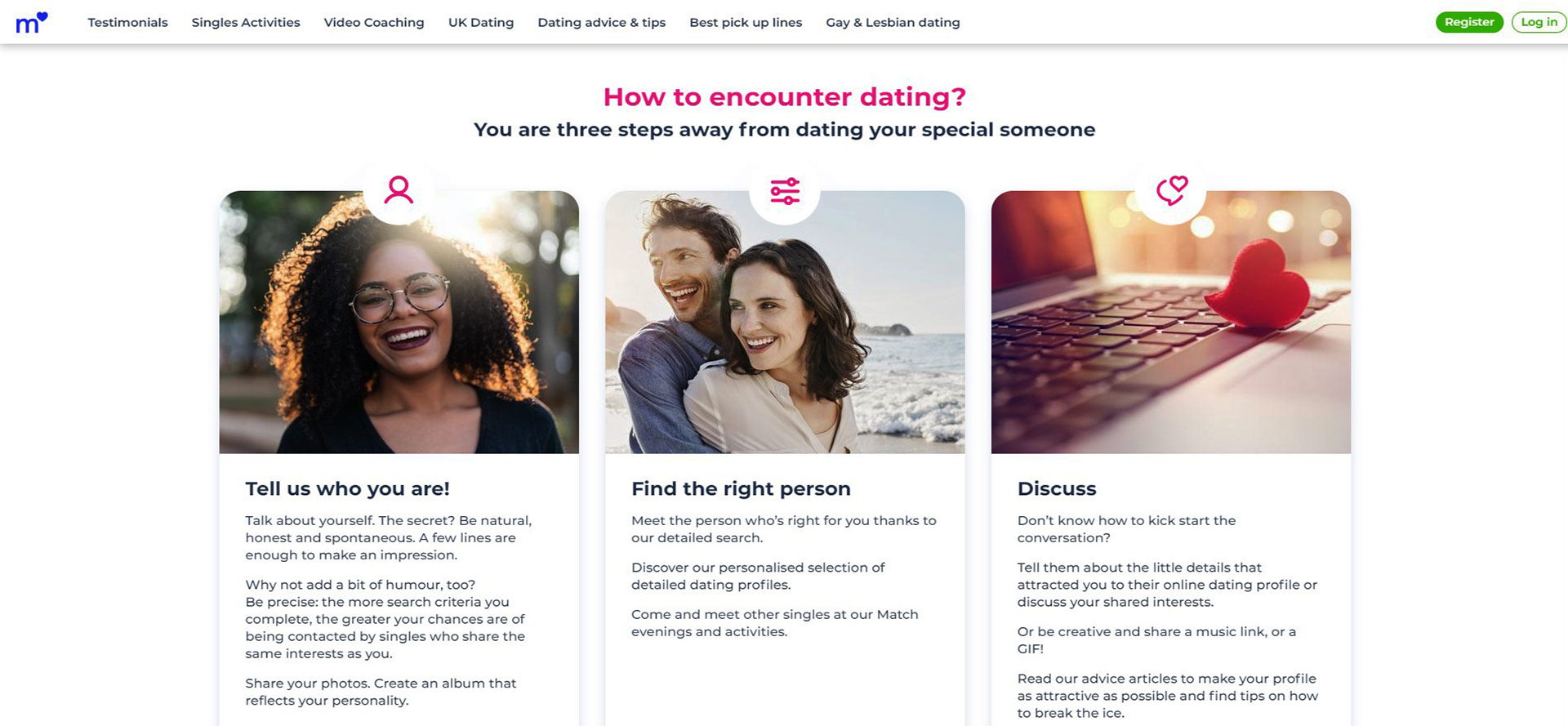
Signing up is quick — email, age, location, gender, what you're looking for, and a photo. You can be inside the site in about five minutes. That speed is nice, but it also means the initial "matching" data is thin. The deeper profile questions (body type, religion, kids, smoking, exercise habits, education, income range) come after, and Match nudges you to fill them in with a completion meter. Plenty of members ignore that nudge. In our sample of 60 profiles pulled from a Chicago search, 21 had fewer than three sentences of written text and four had a single photo. Detailed profiles exist, but they're not the default.
The first impression of the interface is dated in places. The desktop version looks like a site that's been renovated a few times rather than rebuilt, with menus that don't always match the app's layout. It's readable and it doesn't hide anything important, but nobody's going to call it slick.
Putting Match's Matching And Messaging To The Test
The Lovezoid review team ran two Match profiles for six weeks — one man, 38, in a large metro area, and one woman, 44, in a mid-size city about 90 minutes from the nearest big market. The gap between those two experiences tells you most of what you need to know.
In the big metro, activity was genuinely good. The man's account sent 40 opening messages over two weeks and got 9 replies, with 3 turning into ongoing conversations and 1 reaching a coffee date. That's roughly a 22% reply rate, which is better than most free apps deliver for men. Search results refreshed with new faces daily, and the "recently active" filter showed hundreds of people logged in within 24 hours.
In the mid-size city, the well-stocked pool ran out in about four days. Widening the distance filter to 100 miles brought back profiles that hadn't logged in for months. Match doesn't hide last-activity information, which we appreciated, but it also keeps showing you inactive accounts inside your daily suggestions. That's the single most annoying thing about the platform: you get excited about a match, then notice she was last online in February.
On the algorithm claim — it does adapt, but slowly and bluntly. The system tracks who you view and like, and after about ten days the daily suggestions clearly shifted toward the age range and profile types we'd been clicking on rather than the range we'd typed into settings. Useful? Somewhat. Precise? No. If you want a matching system that digs into values and personality with long questionnaires, a quiz-driven approach to compatibility will feel more thorough than what Match offers.
The tools themselves are practical rather than clever:
- Search filters — genuinely strong, and the best reason to pay. You can stack age, distance, height, body type, kids, religion, education, drinking and smoking habits, and keyword search across profile text. Very few platforms let you filter this precisely.
- Likes and Winks — free to send, and the most common way people signal interest without paying.
- Messaging and chat — requires a subscription for meaningful back-and-forth. This is the paywall that defines the whole experience.
- Discover / swipe stream — a card-style browse mode in the app. It works, but it's the least interesting part of Match and feels bolted on.
- Read receipts and profile boosts — sold as add-ons or bundled with higher tiers.
The mobile app on iOS and Android is the better experience overall — faster, cleaner, and notifications arrive reliably. It's free to download. Two complaints: the app buries some search filters behind extra taps, and it pushes promotional prompts hard. In one 20-minute session we counted five separate upgrade or add-on offers.
The Real Cost Before And After The Upsells
Here's where honesty matters most, because Match's pricing is not as simple as the signup page suggests.
The free account lets you build a profile, browse, use search filters, send likes and winks, and see who liked you. It does not let you carry on a normal conversation. You'll get notifications that someone messaged you, and you'll need a subscription to read and reply properly. That's the business model in one sentence.
Standard plans in the USA run roughly $95.99 for three months, $137.99 for six months, and $227.99 for twelve months. Premium adds features like message read status and profile highlighting, at roughly $104.99 for three months, $149.99 for six, and $239.99 for a year. Broken down, the twelve-month Standard plan lands near $19 a month, while three months works out to about $32 a month. Match, like most paid sites, prices the short commitment painfully so the annual deal looks obvious.
Then come the add-ons. Boosts to push your profile to the top of searches, "Super Likes" to stand out, and message highlighting are sold separately or in bundles. None are required, but the interface keeps suggesting them, and a heavy user could easily spend $10 to $20 a month more than the base subscription. There are also regular promotions and discount codes floating around — first-time subscribers often see 30% to 50% off, and it's worth waiting for one rather than paying full sticker price.
Two practical warnings from our testing. Subscriptions auto-renew by default, and turning that off takes a trip into account settings rather than a single obvious button — this is the most common complaint we see from users. And the cheapest tier's "guarantee" offers you extra free months if you don't meet anyone, but only if you met specific profile and messaging requirements during your paid term. Read that fine print before counting on it.
So is premium worth it? If you live within reach of a metro area and you actually plan to log in three or four times a week, yes — the reply rates and filter quality justify around $20 a month. If you're going to check in twice a month, you're renting a mailbox you never open. Worth trying with a free account first to gauge how many active people are within 25 miles of you before you hand over a card.
Safety Tools, Privacy Controls And Real Complaints
Match screens new signups against public sex offender registries in the USA, offers optional photo verification, and includes safety features like a shareable date check-in through the app and the ability to block or report from any profile. Reports get handled, though not instantly — in our testing a reported profile disappeared within about 48 hours.
Bots and scams? Fewer than on free platforms, and that's the honest upside of the paywall. But "fewer" isn't "none." We ran into three profiles in six weeks with the classic pattern: model-quality photos, thin bio, quick push to move the conversation to a messaging app. One asked about crypto within four messages. If someone rushes you off the platform, that's your signal regardless of what site you're on.
Privacy controls are decent. You can browse incognito on paid plans, hide your profile, control who sees your online status, and delete your account and data. What you can't do is stop the platform from recommending you to people outside your stated preferences.
You should also know who Match is not for. If you want casual, low-commitment dating with no monthly bill, a swipe-based app for quick matches or a free-to-chat social dating platform fits your budget better. If you're 55 or older, the age-focused options built for daters looking for later-life partners tend to have a denser pool of peers, and if you're after a very specific arrangement rather than a relationship, clearly defined arrangement dating is a different world entirely.
Final Verdict on Match
Match earns its reputation, but not for the reasons its ads suggest. It's not the matching algorithm — it's the combination of serious, paying members and the best search filters in mainstream online dating. Our Lovezoid rating lands at a solid recommendation with clear conditions attached.
- Best for — relationship-minded daters aged 30 to 55 living within reach of a US metro area, who want filters and intent rather than endless swiping.
- Skip it if — you're in a low-population area, you want casual dating, or you won't log in at least a few times a week.
- Money reality — around $19 to $32 a month depending on term length, plus optional add-ons that add up; wait for a promo and check auto-renew settings immediately.
- Main frustrations — inactive profiles shown as suggestions, constant upgrade prompts, and a dated desktop interface.
Build a free profile, run a search inside 25 miles filtered to members active this week, and let the actual number of real people decide whether Match deserves your money — registration costs nothing, and if the pool looks thin, the comparison table above points to better fits.
FAQ
Are the profiles on serious matchmaking sites real, or is it mostly bots and inactive accounts?
Most profiles on established paid matchmaking platforms belong to real people, but a large share of them are inactive or abandoned accounts. A useful trick is to filter by "active within the last week" — if your search results shrink dramatically, the local member pool is thinner than the site advertises. Outright bots are rarer on subscription sites than on free apps, since scammers avoid paying, but you'll still run into occasional romance-scam attempts that push you to move to text or another messaging app within minutes.
How much does a matchmaking subscription actually cost per month in the USA?
Expect roughly $20–$45 a month on a 6- or 12-month plan, and $35–$60 if you pay month to month. The single-month price is almost always the worst value, and "discounts" on longer plans mean you're charged the full amount upfront, not monthly. Also watch for automatic renewal — most of these platforms renew by default, so cancel auto-renew right after you sign up if you only want one term.
Paid matchmaking site vs. free mainstream apps — which one is actually better?
It depends on what you're looking for and where you live. Free mainstream apps have far more users, especially under 30 and in big cities, so they're better for volume and casual dating. Paid matchmaking platforms attract fewer but more intentional members — often 35+, divorced, or looking for a long-term relationship — and detailed profiles make it easier to screen. In smaller towns, however, a paid site's member pool can be so small that free apps are the only realistic option.
How long does it usually take to get a real date, not just messages?
Plan on two to six weeks of consistent activity before your first in-person date. Reply rates on these platforms are typically 10–20% for men and much higher for women, so men usually need to send a lot of personalized first messages. The people who get dates fastest do three things: complete their profile with multiple recent photos, log in daily so they appear in "active" searches, and suggest a coffee or drink within the first week of messaging instead of chatting for a month.
I'm in my 50s and just out of a long marriage — is this type of site right for me?
Yes, this is actually the core demographic for serious matchmaking platforms — the 45–65 age range is where their member numbers are strongest. Interfaces are generally built for desktop as well as phone, so you don't need to be tech-savvy. The main adjustment is emotional, not technical: expect some ghosting and mismatched expectations, and treat the first few dates as practice rather than proof that online dating "doesn't work." Never send money to anyone you haven't met, no matter how convincing the story.