




The biggest mistake people make with Twoo is treating it like a serious matchmaking service. They fill out a hundred profile questions, wait for the algorithm to hand them a soulmate, and then get annoyed when what actually shows up is a fast-moving stream of casual chat. This Twoo review fixes that expectation gap: Twoo is a social discovery network with dating attached, and once you use it that way it makes a lot more sense. Our verdict up front — it's legit, not a scam, and genuinely fun for low-pressure browsing, but the free version is thin, the paid features are convenience upgrades rather than must-haves, and anyone hunting for a long-term relationship with detailed filters will run out of patience fast.
Best for: people in their 20s and 30s who like casual chatting, meeting folks abroad, and swiping without a big commitment. Skip it if: you want deep compatibility matching, verified-only profiles, or a serious relationship pipeline.
Signing up costs nothing, so the cheapest way to test my conclusions is to make a free account and look around for twenty minutes.
What Is Twoo, Exactly?
Twoo launched in 2011 out of Belgium and was later absorbed into the same corporate family as several other large social-discovery apps. It's available in roughly 38 languages and claims well over 180 million registered accounts across nearly 200 countries, with something in the range of 12 million monthly actives. That "registered" number is marketing math — plenty of those accounts are long dead — but the platform is undeniably big. It's fully available in the USA on desktop, mobile web, iOS, and Android, though the American user base feels smaller and more scattered than the European and Latin American crowds. If you're in New York, Los Angeles, or Miami you'll have plenty to look at. In a mid-sized Midwestern city, expect the local pool to thin out within an hour of browsing.
Signing Up Takes Minutes
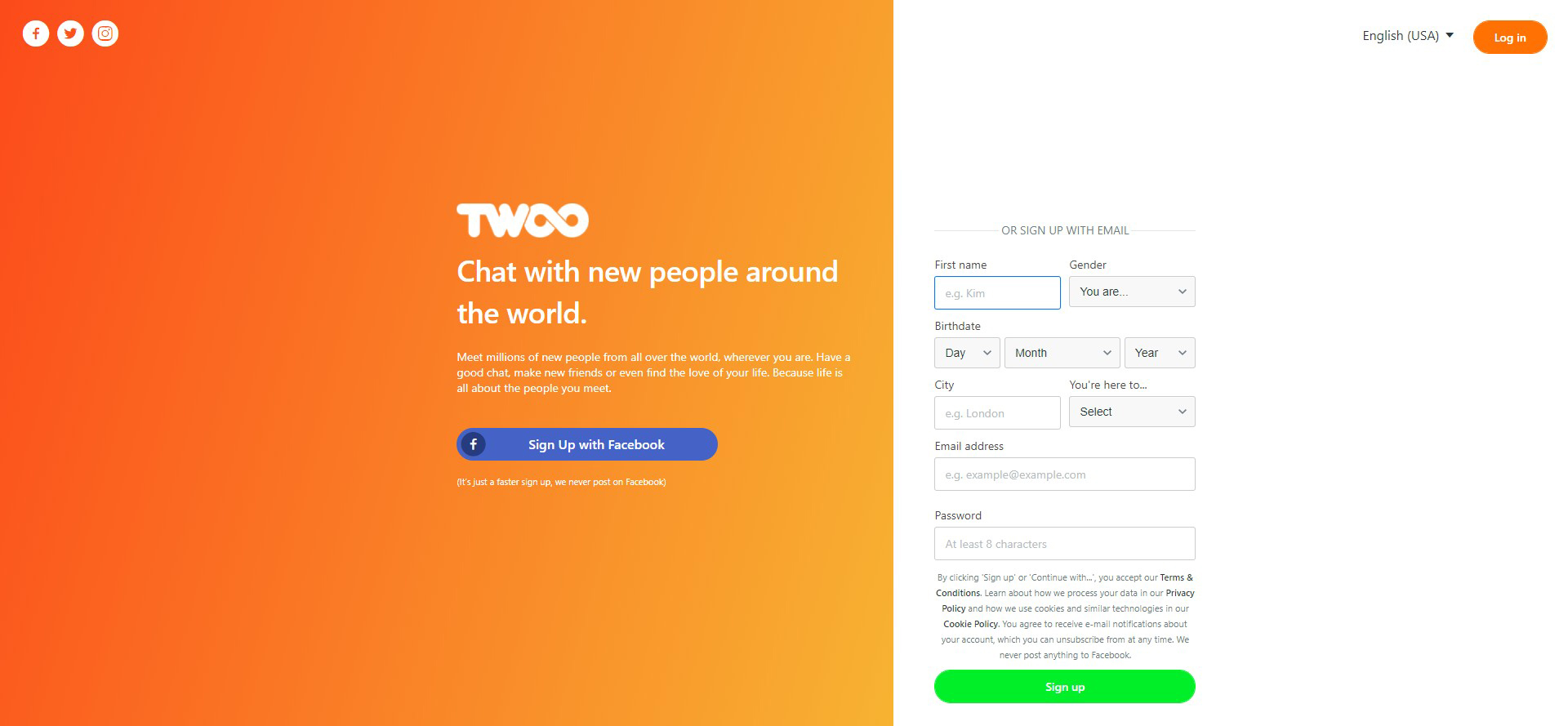
Registration is one of the easiest parts of the whole experience. Lovezoid's review team tested Twoo over several weeks in 2026, and getting an account live took under three minutes — email plus password, or a social login, then gender, birthday, city, and what you're looking for. There's no personality test, no essay prompts, no forced questionnaire before you can see the site. Compared to platforms that make you spend twenty minutes on intake forms, that's refreshing.
You do need to confirm your email before the account fully unlocks, and the minimum age is 18. After that, Twoo pushes you toward two optional verification steps: uploading a photo of yourself making a "V" sign with your hand so your face is clearly visible, and linking a social media account. Both put badges on your profile. Neither is mandatory, which is the first real weak spot — unverified profiles browse and message just fine, so those badges tell you who bothered rather than who's real.
The onboarding then dumps you into a photo upload screen and a set of profile questions. Twoo has around 100 of them, covering everything from whether you'd move abroad for love to how you feel about pets. Answering them isn't required, but it's the engine behind the site's matching: people whose answers line up with yours get surfaced higher in your discovery feed. It's a soft compatibility layer rather than real matchmaking, and the site is fairly honest about that. Filling out 30 or 40 answers took me about eight minutes and noticeably changed who appeared in my feed, so it's worth doing.
Annoyances start early. Within the first session I got prompted three separate times to upgrade — once during signup, once after my first profile view, once when I tried to see who liked me. The interface is clean and the color scheme is friendly, but the upsell rhythm makes the free tier feel like a demo.
Who You Actually Find
The gender split leans female at roughly 60/40, which is unusual and one of Twoo's real advantages for men. Most members fall between 18 and 40, with a long tail up into the 50s. If you're older and want a crowd built around your age bracket, this isn't the place — you'd be better served by platforms built for daters over 50, where the whole design assumes a different pace.
Profile quality is the most inconsistent thing about the site. A good Twoo profile has four or five photos, a short "about you" blurb, city, job, and 50-plus answered questions — enough to actually decide whether to message. A bad one has one blurry selfie, no text, and zero answers. In our testing, roughly half the profiles we opened fell into that second group. The design makes this worse: the discovery feed shows big photos and very little text, so you swipe on looks and only learn anything after you've matched.
Activity levels were better than I expected. The site shows online status and last-active timestamps, and during evening hours in US time zones there was a steady flow of people genuinely online, not just logged-in ghosts. During weekday mornings it was dead. Twoo also runs a game-like "Discover" mode where you rate profiles quickly, and a couple of light social features — visitor lists, a popularity meter — that make it feel more like a social network than a dating service. Some people love that. Others find it distracting.
Bots and fakes? They exist, and I'd call the level moderate rather than terrible. I flagged four accounts in two weeks: two were obvious sketchy links in an opening message, one was a stolen model photo, and one pushed a "chat with me on another app" script within four messages. Twoo's report tool is easy to reach from any profile and the reported accounts disappeared from my feed quickly. That's better handling than a lot of large free platforms manage, but the volume means you should never send money, click outside links, or move to another messaging app early. If someone's photos look like a magazine shoot and their answers are blank, they probably are.
Messaging and Its Paywalls
Here's where the free-versus-paid line gets drawn hard. On a free Twoo account you can browse, like, answer questions, and chat with people who have their inbox open to the public or who've liked you back. What you can't reliably do is start conversations with whoever you want, in volume. Hit the limit and you get the upgrade screen.
Messaging itself is simple: open a profile, tap "Chat," type. There's no voice notes, no video calling, no icebreaker prompts, no built-in games to break the silence. Photos can be sent inside chats. It works, and it's fast, but the toolkit is basic for 2026 standards — if you're used to apps with video verification and in-chat prompts, Twoo will feel a generation behind.
Response rates were the honest surprise. Our Lovezoid experts sent 40 opening messages from a male profile with four photos and a filled-out question section. Fourteen got replies, and six turned into conversations of more than ten messages. That's around a 35% reply rate, which is solidly above average for a big free platform. The catch: several of those chats fizzled into nothing because people treat Twoo like a social app, not a date-planning tool. Only two exchanges got as far as swapping numbers.
So is the traffic worth the friction of the paywall? For most people the answer depends on how quickly you get bored. Twoo rewards volume and casual energy, not carefully crafted long messages.
You will get more out of this site with three good photos and 40 answered questions than with any subscription. Fix the profile first, then decide about paying.
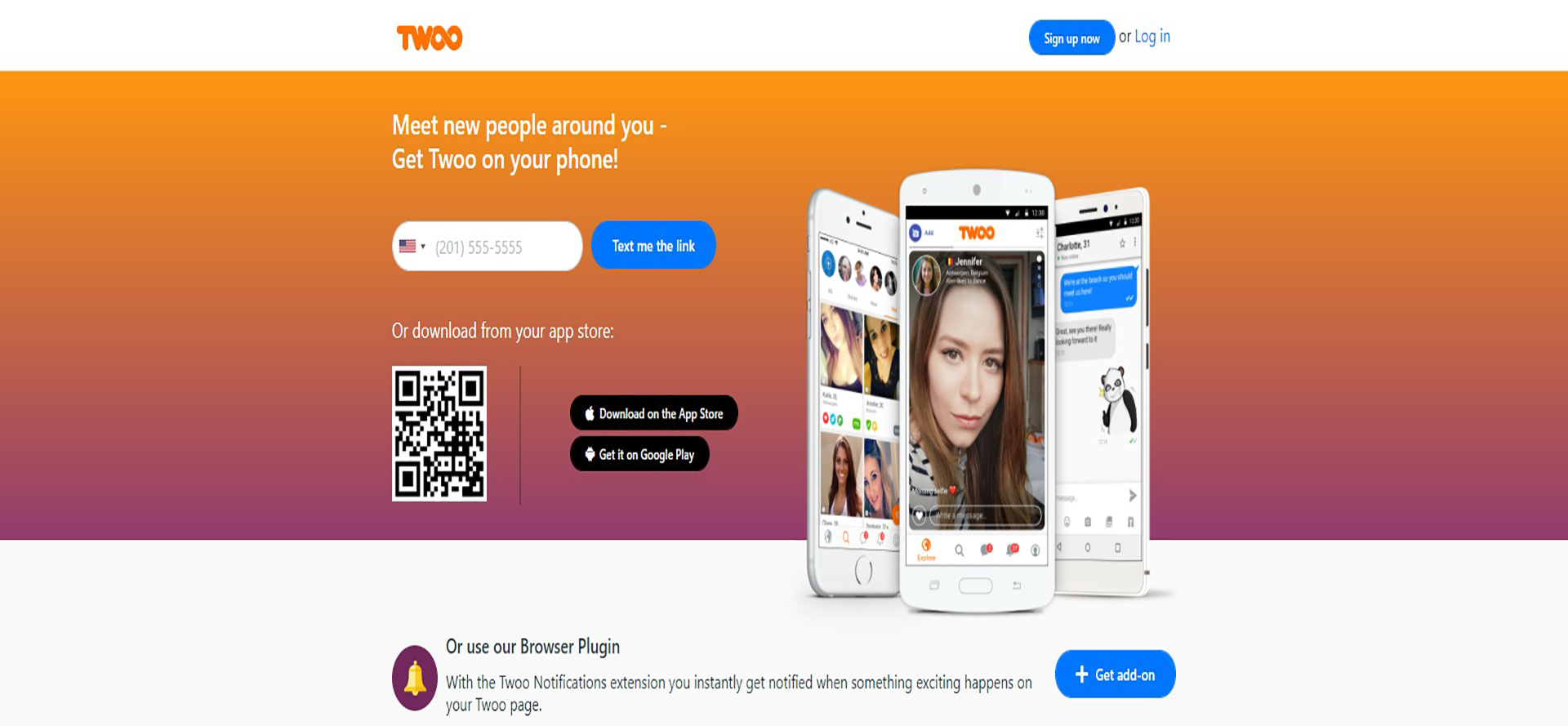
The mobile app is the better version of Twoo. It's quicker than the mobile site, notifications actually arrive, and the swipe-style discovery feels natural on a phone. It's also where the design shows its age — some menu screens look like they haven't been touched in years, and the app occasionally reloads your feed from the top, which is maddening when you were 60 profiles deep. The desktop site is fine for editing your profile and reading longer chats.
Paying for Twoo Premium
Premium runs about $12.99 for one month, drops to roughly $10.33 per month on the three-month plan, and about $7.83 per month on six months. In US dollar terms that's mid-range — cheaper than the big subscription-first dating sites, more expensive than free apps with credit packs. Prices shift with promotions, and Twoo does run occasional discount codes, though they're not frequent enough to plan around.
What you get for the money:
- See who viewed your profile and who liked you
- Contact more users per day (up to around 25)
- Invisible browsing mode
- Filtered search including "most popular" users
- Fewer ads and upsell interruptions
My honest read: this is a convenience package, not a results package. The "who viewed me" list is the only feature that meaningfully changed my outcomes, because it pointed me at people who'd already shown interest. Invisible browsing matters if you live somewhere small and don't want coworkers seeing you. The daily contact limit lift is useful if you message a lot. None of it makes Twoo into a compatibility-driven service, and the search filters remain basic — age, distance, gender, a handful of extras. If precise filtering is what you need, sites built around detailed questionnaires do that job far better.
On privacy, Twoo is average. You can hide your online status, block users, and remove yourself from visitor lists with Premium, but there's no way to hide photos from non-matches and your profile is visible broadly by default. Deleting an account is possible from settings, though it takes a few clicks to find. The most common user complaints we found echoed our own experience: recurring subscription charges that surprised people, and the amount of nudging toward the paid tier. Turn off auto-renewal the day you subscribe.
Because Twoo blurs the line between socializing and dating, some people end up wanting something more focused — whether that's a straightforward swipe-and-meet app, a bigger social discovery network, or an arrangement-based platform with clearer intentions.
Final Verdict on Twoo
Twoo is a real, functional, moderately fun platform with a big international audience, a female-leaning gender split, and reply rates better than I anticipated. It's also basic where it counts: shallow search filters, no modern communication tools, patchy profile quality, and a free tier that exists mainly to sell you Premium. It's best for sociable daters in their 20s and 30s who enjoy casual chat, don't mind sorting through empty profiles, and are open to talking with people in other countries. Look elsewhere if you're over 50, want verified-only members, or need a site that filters hard for long-term compatibility. Overall, I'd score it around 3 out of 5 — decent value, limited ambition.
If that sounds like your speed, make a free account, add three real photos, answer 40 questions, and give it a week before spending a dollar. You'll know quickly whether your area has enough people online to make it worthwhile — and if it doesn't, the comparison table above points to options that may suit you better.
FAQ
How can you tell if the profiles on a social discovery platform like this are real people?
Look for accounts with multiple photos in different settings, a filled-out bio, and linked interests — thin profiles with one glamour shot and no text are the usual red flags. On older social-discovery platforms, a large share of accounts are inactive rather than outright fake, so check when the person was last online before investing time. If someone moves the chat to another messaging app within minutes or starts hinting at money problems, stop replying and report them.
What does it actually cost once you run out of free features?
Expect roughly $10–$20 per month for a premium subscription, with cheaper per-month pricing if you commit to three or six months up front. Many platforms of this type also sell separate credit packs for extras like profile boosts or gifts, which is where costs quietly add up. Subscriptions typically auto-renew, so cancel through your account settings or app store before the billing date if you only want one month.
Is it worth using a platform like this in the USA when the user base is mostly international?
It depends on what you want — American users often find far fewer local matches here than on mainstream apps, especially outside big metro areas. The distance filter can look busy while most nearby results are dozens of miles away or logged in months ago. If you're open to chatting with people abroad or you're traveling, it has value; if you want a date this weekend in your own city, a mainstream app will move faster.
How long does it usually take to go from matching to an actual date here?
Realistically, plan on a few weeks of consistent messaging rather than days. The swipe-and-game format on these platforms generates a lot of low-effort matches, so a big chunk of conversations die after two or three messages. Users who ask a specific question in the first message and suggest a coffee or video call within a week get results much faster than those who chat endlessly.