





Here's the blunt truth about paid matchmaking in the USA: most of what you're buying is a human being's attention, and that costs a lot more than an app subscription. This Tawkify review looks at whether that human attention is worth the four-figure price tag, because Tawkify is not a dating app in any normal sense — there's no swiping, no browsing, no messaging.
Quick verdict: Tawkify is legitimate and the matchmakers are real people, but it's expensive, slow, and gives you almost zero control. It's best for busy professionals over 30 who are done with apps, want serious dating, and can comfortably spend $1,000–$5,000 on the search. Skip it if you want to see photos before you commit, need dates this month, or can't stomach paying for matches that come with no guarantee you'll like them.
What Is Tawkify?
Tawkify launched in 2012 and pairs each paying client with a human matchmaker who hand-selects introductions and then arranges the actual date — including where you go. The pool sits somewhere around 70,000 profiles, with roughly 50,000 in the USA, so it's available nationwide but works best in bigger metro areas where the matchmaker has more people to pull from. The audience skews toward straight singles looking for long-term relationships, and the gender split leans slightly male. Unlike almost every platform we cover at Lovezoid, you never search, never browse, and never message anyone — you fill out a profile, talk to a human, and wait.
Tawkify's Big Promise — Does It Hold Up?
The pitch is seductive if you're tired of apps: no endless scrolling, no ghosting, no writing the same opening line 40 times. A real person learns what you want, screens candidates for you, and sets up a date. Tawkify's marketing has long referenced an 80% success rate in helping people find a partner, plus the promise of a "dating concierge" who handles the awkward logistics.
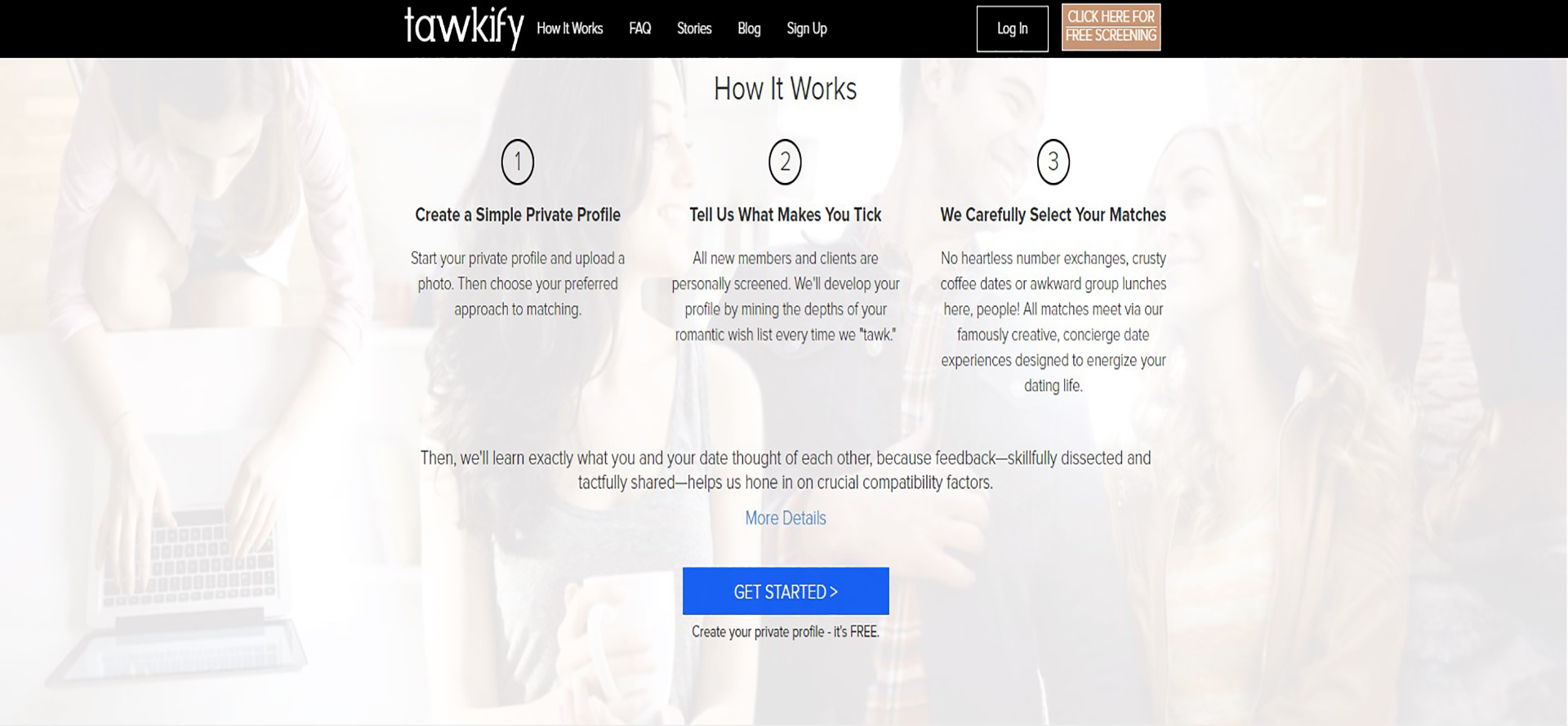
First impressions were mostly good. The sign-up flow took me about 12 minutes and asked for name, gender, age, relationship status, location, ethnicity, sexual preference, income, occupation, physical details and what you actually want out of dating. Nothing is skippable, which is annoying but makes sense — a human is reading it. You verify by phone call, upload two photos that stay internal (matches never see them), and then explain in your own words what problem you want Tawkify to solve.
That last question is the one that matters. When our Lovezoid tester wrote a vague answer, the follow-up call was generic. When she rewrote it with specifics — "I want someone who wants kids in the next three years and doesn't work weekends" — the conversation got noticeably sharper.
But the claims raise obvious questions before you pay:
- What exactly counts as "success" in an 80% figure that isn't independently audited?
- How many local candidates actually exist in your city?
- What happens if you dislike your first two or three matches?
- Why can't you see a single photo before showing up?
What We Actually Found in Testing
The matchmaker is real. That's the headline. The intro call in our 2026 testing ran close to 45 minutes and covered dating history, dealbreakers, and past relationships in more depth than any questionnaire could. This part genuinely felt different from filling out a compatibility quiz and hoping an algorithm sorts it out.
Where it gets shaky is the pace. The client plan promises roughly one date per month, and "roughly" is doing real work in that sentence. Our first introduction took just over five weeks to arrive. Complaints from other users echo that — people report gaps of two or three months between matches, especially outside major cities. If you live in a mid-size market, the local pool simply isn't deep, and no amount of human curation fixes a small pool.
Then there's the blind date format. You get a first name, a short description, and a time and place. No photos, ever, until you're sitting across from them. Tawkify frames this as removing surface-level judgment, and there's something to that — you actually talk instead of scanning for red flags. But it's also a gamble on your evening. Two of the people we spoke to said their first introduction was pleasant but physically not their type at all, and that's an expensive coffee.
Things that genuinely work well:
- Date logistics are handled — venue, time, reservation. You just show up.
- Feedback loops matter: after each date, you tell the matchmaker what worked, and the next pick usually improves.
- No bots, no catfish, no crypto scammers. Every candidate spoke to a human first.
- Zero message-fatigue, which is a real relief if you've burned out on apps.
Things that frustrated us:
- No search function, no profile browsing, no way to say "actually, show me someone else."
- No messaging between members at all, on any plan.
- There is no Tawkify mobile app — you use the mobile web version, which works but feels dated.
- Response times from matchmakers varied wildly; some replies took three or four days.
The interface itself is simple, almost bare. That's fine, since you barely use it. But it does mean that between introductions you have literally nothing to do — no activity feed, no "who viewed you," nothing. Compared with the constant motion of fast-moving swipe apps, Tawkify can feel like the lights went out.
If that silence sounds unbearable, this probably isn't your service. Some people find it peaceful; others find it maddening.
The Real Cost of Tawkify
Tawkify does not publish clear pricing on its site, and that alone deserves a mention. Prices shift by location and by what the matchmaker thinks your search requires, and there are two completely different levels of involvement.
Free account: You can register, verify your phone, and complete your profile without paying. That's it. No matches, no matchmaker, no dates. It's a data-collection step, not a usable free tier.
Member (~$99/year): Your profile sits in the database so paying clients can be matched with you. You get no matchmaker and no guaranteed dates. You might get introduced to someone; you might never hear a word. For $99 it's a lottery ticket, not a service.
Client (the real product): This is where the money goes. Packages we saw ran around $1,497 for three months, $2,694 for six months, and $5,088 for twelve — roughly $425 to $500 per month depending on length. That buys a dedicated matchmaker, curated introductions, and arranged dates at about one per month.
Do the math and a twelve-month client package works out to around $424 per introduction if you get all twelve dates. If you get eight, it's $636 each. That's the number to sit with before you sign.
What you're actually paying for:
- A human's time screening candidates instead of an algorithm's guess
- Pre-vetted people who have spoken to staff — a real filter against fakes
- Date planning and booking done for you
- Honest feedback after each date, which most people never get
Is premium worth it? Honestly, it depends entirely on how you value your own time. If you bill $200 an hour and hate apps, spending $1,500 to outsource three months of dating admin is defensible. If you're comparing it to a $30-a-month subscription where you control everything, it looks absurd. There are no promo codes we've found, and discounts are usually negotiated on the intro call rather than published.
If that price tag makes you wince, it's worth spending a week with a lower-cost option first — plenty of people find what they need on question-based matching platforms or, if you're in the 50-plus bracket, on sites built around mature singles. Testing a cheap option costs you nothing but time and tells you a lot about what you actually want.
Skip It If You Want Speed and Control
On safety, Tawkify is one of the cleaner services we've reviewed. Phone verification is mandatory, every candidate has spoken with a matchmaker, and there's no open messaging system — which removes the single biggest channel for romance scams. Our Lovezoid team saw no bot activity, no fake profiles, and no suspicious links, mostly because the structure makes them impossible. Your photos stay internal, your profile isn't public, and you're not searchable. For privacy-conscious people, especially anyone in a small professional community, that's a genuine advantage.
The complaints that do exist aren't about safety — they're about value and communication. The recurring themes: slow match delivery, matchmakers who change mid-contract, difficulty getting refunds, and matches that didn't reflect stated preferences. Because Tawkify sells a service rather than access, disputes end up being about whether the service was delivered well, and that gets subjective fast. Read your agreement carefully, especially the cancellation and pause terms.
Tawkify makes sense for you if:
- You're 30–55, employed, and serious about a committed relationship
- You live in or near a large US metro area
- You've tried apps and burned out on the volume
- Four figures for the search doesn't hurt your budget
Look elsewhere if:
- You want to see photos and pick for yourself
- You're after something casual or short-term
- You live in a rural or small market
- You need dates within the next two weeks
People who want more autonomy usually do better on large-volume platforms with open browsing, and those interested in more arrangement-style dating are looking for a completely different model than what Tawkify offers.
Final Verdict on Tawkify
Tawkify is legitimate, safe, and genuinely different from the app crowd — but it's a premium concierge service with real limitations, and the price only makes sense for a specific kind of buyer.
- Legit? Yes. Real matchmakers, real vetting, no bot problem.
- Worth the money? Only if your time is worth more than roughly $425 per introduction and you live in a major metro.
- Biggest drawbacks: No app, no photos before dates, no browsing or messaging, and slow pacing.
- Best fit: Busy professionals over 30 who want commitment and are done swiping.
Registering and completing your profile costs nothing, so if the concept appeals, start there and use the intro call to ask hard questions about your local pool before you pay — and if the price or the blind-date format doesn't sit right, check the comparison table above for options that give you far more control for far less.
FAQ
Are the people a matchmaker sets you up with real paying clients, or just names pulled from a free database?
It's usually a mix, and that surprises a lot of first-time clients. Matchmaking services build their pool from paying members plus a much larger group of people who signed up for free and agreed to be considered as matches. Everyone is interviewed or screened before a date is arranged, but you should assume some of your matches are not investing money in the process the way you are, which can affect how motivated they seem.
How much does a matchmaking service actually cost, and can you get your money back if the dates are bad?
Expect several hundred dollars for a single introduction and roughly $1,000 to $5,000 or more for multi-date packages, with prices varying by city and how specific your criteria are. Refunds are rarely offered once dates have been arranged — most contracts guarantee a number of introductions, not chemistry. Read the cancellation terms before you pay, and ask in writing what happens if a match cancels or no-shows.
Why pay a matchmaker when mainstream apps are free?
The main thing you're buying is time, not access. A matchmaker screens, schedules, and books the venue so you skip endless swiping and dead-end chats, and you never appear in a public profile that coworkers or clients could find. The trade-off is volume and control: you might get one or two dates a month instead of dozens of conversations, and you don't choose who they are.
Is it safe to meet someone on a blind date you didn't pick yourself?
Generally yes, because dates are set in public venues like restaurants or coffee shops and both people have been interviewed by a real person first. Still, screening is not a background check unless the service explicitly says so — ask. Tell a friend where you'll be, arrange your own transportation, and remember you can end a date early and report the experience to your matchmaker.
What kind of person actually gets the most out of a matchmaking service?
It works best for busy professionals in their 30s to 50s who live in or near a major metro area, are clearly looking for a serious relationship, and have money they'd rather spend than more hours swiping. It works poorly for people in small towns or rural areas, where the local pool may be too thin to produce good matches, and for anyone who wants to vet photos and profiles before agreeing to meet. If you're on a tight budget or open to casual dating, mainstream apps will give you far more options for free.